

Invited Plenary speakers:
- Professor Bernardo Rodrigues, University of Pretoria
- Professor Farai Nyabadza, University of Johannesburg
- Professor Kerstin Jordaan, University of South Africa
- Prof Craig Pournara, University of the Witwatersrand
- Prof Moosa Gabeleh. Ayatollah Boroujerdi University, Iran
Professor Bernardo Rodrigues

Biography
Bernardo Rodrigues is Professor of Mathematics at the University of Pretoria (UP). Bernardo studied at the Pedagogic University Enrique JosÈ Varona in La Habana, Cuba where he earned a Licenciatura in Mathematics and Education (equivalent to an MSc) and moved to the former University of Natal, in Pietermaritzburg, South Africa where he obtained a BSc Honours (1998), MSc in 2000 and a PhD in Mathematics in 2003. Although his early work concerned the theory of finite groups, in particular the study of the extension problem, his current research interests concern with the interplay between Algebraic Coding Theory, Finite Groups, Modular Representation Theory of Finite Groups and Combinatorial Design Theory as well as Computatational Group Theory and Axial Algebras, including both the concrete and the abstract aspects of these subjects. His recent papers involve modular representation of finite simple groups, as well as the application of this to the realization of finite simple groups as permutation groups of automorphisms of linear codes. He is the recipient of a Fulbright Scholar Award (2017) and during the period 2016 – 2023 he participated in three Erasmus Mundus Plus Academic Exchange Programmes at Ghent University (Belgium) and University of Rijeka (Croatia). He has held several visiting positions in several African countries, at universities in the United States, Australia, New Zealand and United Kingdom, most frequently at the University of Birmingham in the UK.Abstract
On two-weight codes invariant under finite simple groups
A linear [n, k, d]-code C is called projective if no two columns of a generator matrix are linearly dependent, i.e. the columns represent pairwise distinct points in a projective (k − 1)-dimensional space or equivalently, if d(C⊥) ≥ 3. A code C is called a two-weight code if all nonzero codewords have weight w1 or w2 (w1 < w2), for some w1,w2. The dual of a two-weight code belongs to the family of uniformly packed codes, i.e., codes in which the number of codewords at distance 3 from a word x which is at distance 2 from the code is constant, and the number of codewords at distance 3 from a word x which is at distance greater than 2 from the code is also constant.
Projective two-weight are associated with strongly regular graphs and uniformly packed codes. The class of 2-(v, k, λ) designs with symmetric difference property (SDP) gives rise to self-complementary codes meeting the Grey–Rankin bound. The set of codewords of minimum weight in a binary linear self-complementary code of even length, meeting the Grey–Rankin bound, constitutes the set of blocks of a quasisymmetric design with the symmetric difference property. Two-weight codes have connection with bent functions and with bent vectorial functions, with divisible codes, self-orthogonal codes and with secret sharing schemes. The study of two-weight codes remains of great interest in coding theory, for although several infinite families of two-weight codes are known, the problem of their complete classification remains open.
This talk will give an introduction to this fascinating interplay by focusing on a small set of examples, chosen mostly for their instructional value. I will illustrate the connections described above with examples of construction of some q-ary two-weight codes and in particular, some binary projective two-weight codes on which finite almost quasisimple groups of sporadic type act transitively as permutation groups of automorphisms. Employing a known construction of strongly regular graphs from projective two-weight codes we will give examples of new strongly regular graphs invariant under the said groups.
Professor Farai Nyabadza

Biography
Farai Nyabadza graduated with an undergraduate degree from the University of Zimbabwe and majored in Geology and Mathematics in 1993. He then did a Master of Science Degree in Mathematics from the University of Zimbabwe in 1998 and completed his Ph.D. in mathematical modelling of infectious diseases in 2003 from the University of Botswana. He proceeded to do a Post-Doc at the South African Center for Epidemiological Analysis (SACEMA), from where he joined Stellenbosch University. He is currently a Professor of Applied Mathematics at the University of Johannesburg, and his research involves the applications of dynamical systems to infectious disease dynamics, substance abuse, and other biological systems. Professor Nyabadza is the current Head of Department of the Department and Mathematics Applied Mathematics at UJ. He has successfully supervised 15 Ph.D. and 59 MSc students throughout his career. He has also written three academic books and has many collaborations globally. He is an editor of four Biomathematics journals and reviews a number of journal articles for national and international journals. He is the former President of the Southern Africa Mathematical Sciences Association, a regional body that thrives on developing Mathematical Sciences in the Southern African region. He is also passionate about motivational speaking and has written a book entitled titled, “Ordering your life for success: Lessons from the number line”
Abstract
The management of infectious diseases has evolved in the past few decades. It is now clear that policies can evolve as a disease progresses in a population, with a good example being the COVID-19 pandemic, where policies were dynamic and at times erratic. In this talk, we consider a number of mathematical models fitted to data and how the fitting is impacted by policy changes. We track the changes in policies using piece-wise systems of differential equations. The focus will be on how such models are formulated, analysed and interpreted. Thresholds that define disease persistence will be established and discussed. The implications of the policy changes are easily seen, and a discussion on how these changes impacted the epidemic is articulated. The results presented have crucial impact on how policy changes affected and continue to influence the trajectory of infectious diseases.
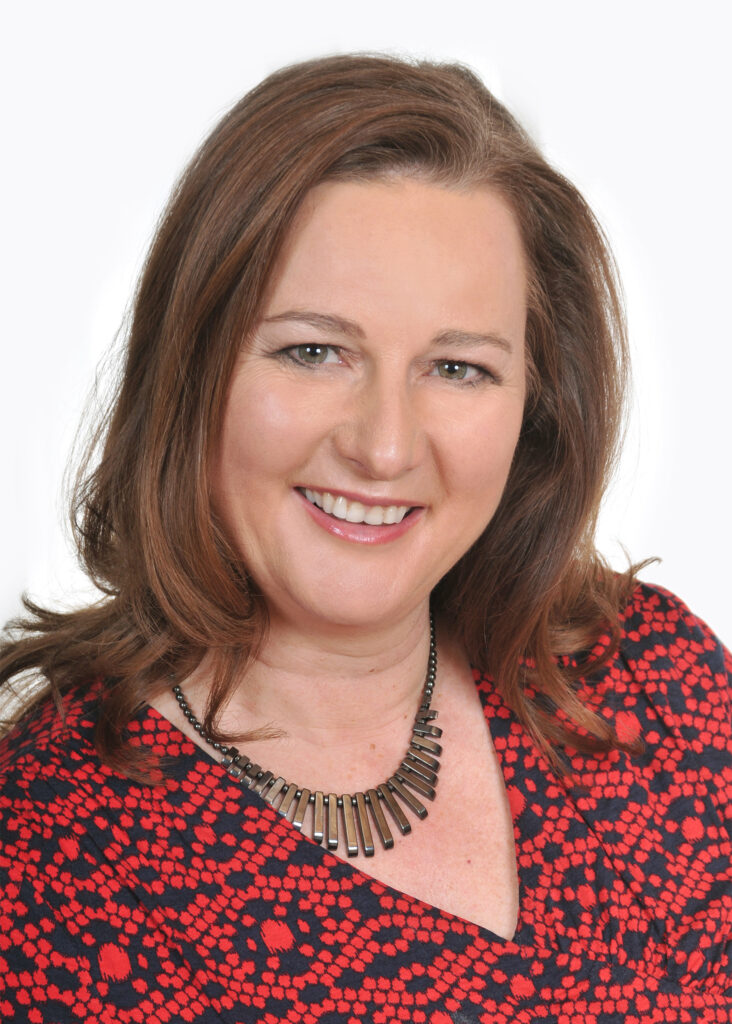
Professor Kerstin Jordaan
Biography
Kerstin Jordaan was a high school mathematics teacher before graduating from the University of the Witwatersrand with a PhD in Mathematics in 2002. She occupied positions at Vista University, University of the Witwatersrand and the University of Pretoria before joining the University of South Africa in 2017 as a full professor in the Department of Decision Sciences. Kerstin has been the part-time executive director of the South African Mathematics Foundation since 2018 and served the academic community as the elected president of the South African Mathematical Society from 2016 to 2019. She is a nominated member of the Academy of Sciences of South Africa and the recipient of a prestigious Royal Society Newton Advanced Fellowship for her research in Special Functions and Orthogonal Polynomials.
Abstract
Orthogonal Polynomials and Symmetric Freud weights
In this talk, I will present some recent results on polynomials orthogonal with respect to exponential weights on the real line, in particular symmetric Freud weights. I will show that the sequence of generalised higher order Freud weights forms a hierarchy of weights. The associated first moment can be written as a finite partition sum of generalised hypergeometric functions. I will describe properties of the recurrence coefficients in the three-term recurrence relation associated with these orthogonal polynomials. Connection formulae between corresponding sequences of generalised higher order Freud orthogonal polynomials in the framework of Christoffel transformations, where the weight is modified by multiplying with a polynomial, are useful in studying properties of the zeros.
Professor Craig Pournara

Biography
Craig Pournara began his career as a high school teacher of Mathematics and Computer Science. He holds a PhD in Mathematics Education and has worked in pre-service and in-service maths teacher education for more than 25 years. He has served as Director of the Marang Centre for Maths and Science Education at Wits, and was a member of the Ministerial Task Team that developed the Teaching Mathematics for Understanding Framework. He is currently Director of the Wits Maths Connect Secondary Project where much of his work has focused on designing professional development and on researching the impact of that professional development on learners’ attainment.
Craig is passionate about improving the teaching and learning of mathematics in South Africa. He longs for the day when more teachers teach mathematics with understanding, and more learners enjoy learning mathematics because it makes sense to them.
Abstract
Title: Senior Phase Mathematics : Do we mind the gap?
It is well-known that learner performance in Senior Phase mathematics is poor. While more attention has been directed towards the Senior Phase in recent years, there is little convincing evidence of its impact at the level of the learner. What does it take to shift the needle in this phase? What changes in policy, in curriculum, in teaching and learning, and in assessment? In this talk I will argue that Senior Phase mathematics comes with challenges in all these areas. But, of equal importance, are the mathematical shifts that have to be navigated in the move to greater abstraction. Drawing from findings of several recent studies, I will challenge us to decide whether and how we mind this gap.
Professor Moosa Gabeleh

Biography
Moosa Gabeleh is an Iranian Mathematician, working in the field of Nonlinear Functional Analysis and more especially Best Proximity Point theory. He defended his PhD at Imam Khomeini International University (IKIU) in 2012 under the supervision of Professor Ali Abkar on best proximity points for cyclic mappings. He did a post-doctoral internship at North-west University (NWU). He is currently a Full Professor in Department of Mathematics at Ayatollah Boroujerdi Unversity. He is the author of more than 100 scientific papers. He was awarded in 2012 for the best paper in Iranian Functional Analysis Award from the Tusi Mathematical Research Group (TMRG).
Abstract
Extensions of Ky Fan’s best approximation theorem using some geometric properties of Banach spaces
Let X be a normed linear space and Y be a nonempty subset of X. A point x∈Y is said to be a fixed point for a mapping T: Y → X if Tx=x. In the case that Y∩ T(Y)=∅, the fixed point equation Tx=x does not possess a solution. In this case it is interesting to ask whether there exists a point p∈Y for which p is closest to Tp. Such a point is said to be a best approximant point.
In 1969, Ky Fan presented some sufficient conditions to ensure the existence of a best approximant point. Fan’s best approximation theorem states that if Y is a nonempty, compact and convex subset of a normed linear space X and T:Y→ X is a continuous mapping, then there is an element p∈Y such that ||p-Tp||= dist(Tp,Y):=inf〖 {||Tp-y||∶ y∈ Y}〗.
Now assume that Y and Z are two nonempty subsets of a normed linear space X and let T: Y→ Z be a non-self mapping. In this situation, a point p^*∈Y is called a best proximity point of the mapping T provided that
|(|p^*-Tp^* |)|=dist(Y,Z)≔inf〖 {||y-z||∶ (y,z)∈ Y× Z}〗.
It is worth noticing that if Y∩ Z≠∅, then the set of all best proximity points of T coincidences to the set of all fixed points of T. So, in order to obtain an extension of Fan’s best approximation theorem, we need to assume that Y∩Z=∅.
In this talk we will present some existence results of best proximity points for various classes of non-self mappings by using some appropriate geometric properties of Banach spaces and then we apply such existence results to survey the existence of optimum solutions to systems of differential and intergrodifferential equations.
Invited Speaker for NITheCS Plenary Session
Professor Nancy Ann Neudauer

Biography
Nancy Ann Neudauer is the Thomas and Joyce Holce Professor of Science and Professor of Mathematics at Pacific University, Associate Secretary (responsible for the scientific program of national conferences) of the Mathematical Association of America (MAA), and Co-Director of the Center for Undergraduate Research in Mathematics (CURM). She received her MA and PhD in Mathematics, with a minor in Business and Law, and her BBA in Actuarial Science and Risk Management, all from the University of Wisconsin.
Nancy’s research in matroid theory, graph theory, and combinatorics has been supported by grants from the Simons Foundation, the Fulbright Program, the National Science Foundation, and an endowed Research Chair, amongst others. She is Program Chair for the Cascadia Combinatorial Feast since 2001, was Visiting Mathematician to the national offices of the MAA, Director of the MAA Dolciani Mathematics Enrichment Grant Program for 13 years, a PI on the NSF-funded META Math (the Mathematical Education of Teachers as an Application of Mathematics) project, Associate Director for PNW Section NExT (New Experiences in Teaching) for 19 years, and recipient of a Distinguished Teaching Award and a Meritorious Service Award. As a Fulbright Specialist, her outreach extends to African Institute of Mathematical Sciences (AIMS) Centres in South Africa, Tanzania, Ghana, Cameroon, and Rwanda and she is the recipient of a Fulbright Global Scholars Award.
Abstract
Title: Models of Undergraduate Research in Mathematics
A well-mentored undergraduate research experience has been shown to be a high-impact practice, with particularly strong effects for students from minoritized groups. While common for decades amongst the lab sciences, undergraduate research has more recently been adopted and institutionalized in mathematics. I will present a few different models, and in particular, discuss the academic-year research and faculty professional development funded through the Center for Undergraduate Research in Mathematics (CURM). CURM has just been awarded its fourth NSF (National Science Foundation) grant, a $1.6 million five-year grant to support faculty and students with minigrants at universities and 2-year colleges throughout the United States.
CURM promotes academic-year undergraduate research in mathematics and statistics based upon a model consisting of (a) training faculty members to mentor students in research, (b) engaging students and a faculty mentor in research during the academic year at their own institution, (c) preparing students to succeed in graduate studies, and (d) advising faculty members on how to maintain consistent undergraduate research including finding resources for other funding sources.